Research Description
Our research will focus on three interrelated directions: (1) The molecular and genetic mechanisms underlying auditory system development; (2) Hearing restoration in various deafness mouse models; (3) Multi-omics analysis of different cell types and subtypes in the auditory system.
The molecular and genetic mechanisms underlying auditory system development
The cochlea is the peripheral sound-detecting organ and contains four main cell types: 1) Outer hair cells (OHCs) that are sound amplifiers; 2) Inner hair cells (IHCs) that are primary sensory cells and decode sound information; 3) Supporting cells (SCs): crucial for maintaining cochlear integrity and serving as a resource for IHC and OHC regeneration; 4) Spiral ganglion neurons (SGNs) that form synapses with IHCs and project sound information to the brain. Ototoxic factors, including genetic mutations, antibiotics, chemotherapy drugs, and aging, can cause degeneration of OHCs, IHCs, and SGNs, leading to hearing impairment. According to the World Health Organization (WHO) report, 0.3% of newborns, 5% of individuals under 45, and 50% of those over 70 suffer from varying degrees of hearing loss. More importantly, hearing deficits not only affect sound perception but also hinder social interaction.
The cochlea develops from posterior placode progenitors (PPP), which give rise to otic placode (vesicle) or epibranchial placode cells. The ventral portion of the otic vesicle ultimately transforms into the cochlea, where neurosensory progenitors diverge into neural or sensory progenitors. Neural progenitors develop into SGNs, while sensory progenitors differentiate into OHCs, IHCs, and SCs. The key questions we aim to address include:
1) How are otic vesicle progenitors specified from the general PPP?
2) How do otic neurosensory progenitors adopt neural or sensory fates?
3) How do cochlear progenitors commit to OHC, IHC, or SC lineages?
Briefly, our long-term research goal is to identify the key genes or gene networks that regulate the proliferation and differentiation of otic progenitors before they commit to the aforementioned cell types. This will undoubtedly contribute to future hearing restoration efforts.
Hearing restoration in deafness mouse models
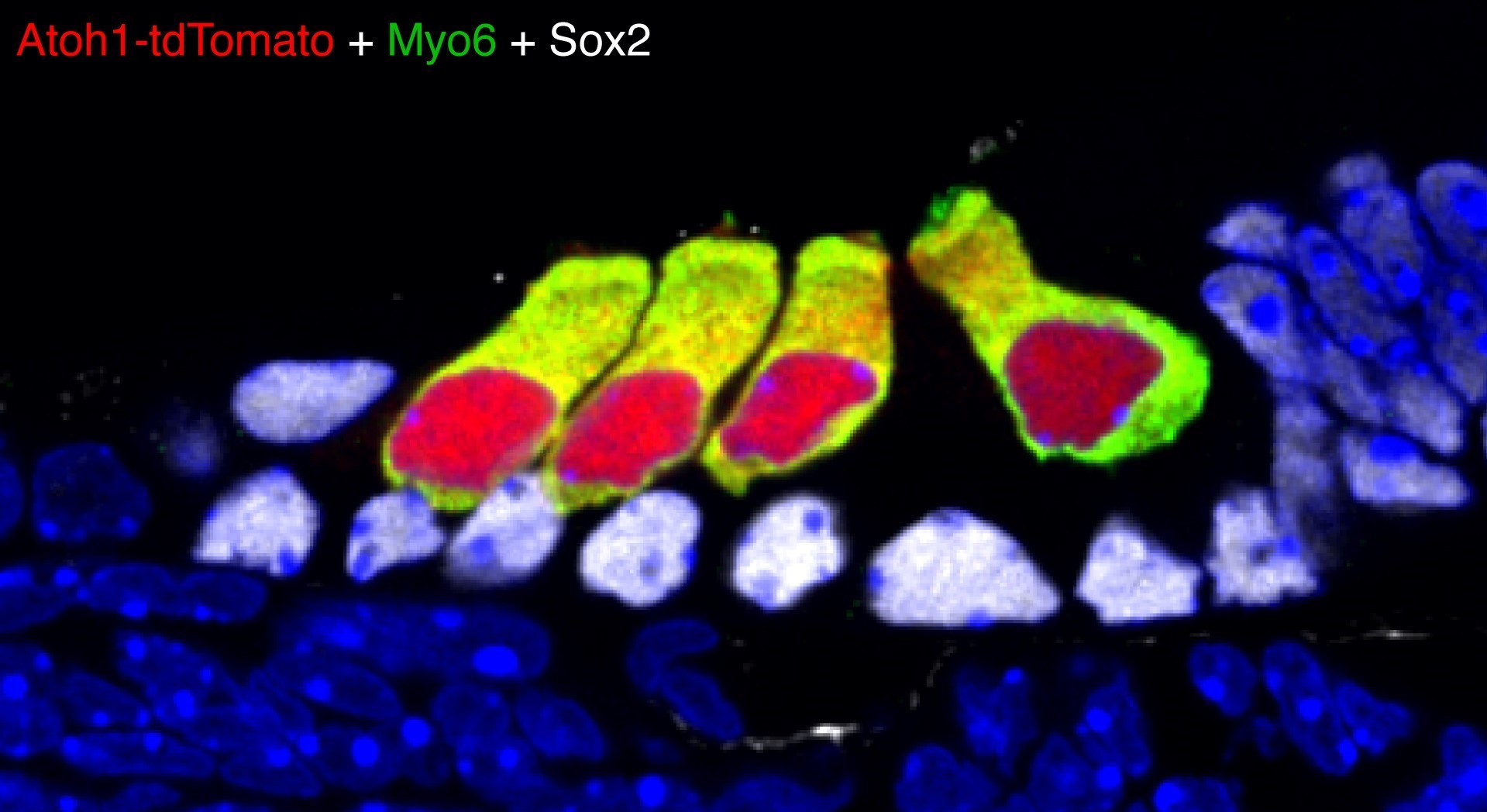
Non-mammalian vertebrates such as birds and fish can restore hearing after trauma by transdifferentiating SCs into hair cells. In contrast, mammals, including mice and humans, lack this regenerative capacity. As a result, the degeneration of hair cells in mammals inevitably leads to irreversible hearing impairment or complete hearing loss. Therefore, achieving hearing restoration in mammals is a critical area of research. To better mimic human deafness, our group has developed distinct deafness mouse models, in which OHCs, IHCs, or SGNs are selectively damaged. Furthermore, we have successfully reprogrammed SCs into IHCs or OHCs by combining Atoh1 with Tbx2, and Atoh1 with Ikzf2, respectively. However, these newly regenerated hair cells fail to restore hearing because they are not fully differentiated or matured.
What are the key barriers preventing hearing recovery in damaged cochleae? Our data suggest that although the ribbon synaptic structures in the newly regenerated IHCs and OHCs are well-formed, their stereocilia (or hair bundles) are dysfunctional. Stereocilia are where the mechanoelectrical (MET) components are located, and defects in stereocilia prevent those newly regenerated hair cells from detecting sound. Identifying the factors critical for regulating stereocilia assembly, as well as discovering genes that, in combination with Atoh1, Tbx2, or Ikzf2, can produce fully functional hair cells with well-developed stereocilia, is essential for improving hearing restoration in damaged cochleae.
Multi-omics analysis of different cell types or subtypes in auditory system
Historically, cochlear cell types have been classified based on location, morphology, and function, which facilitates communication across research groups but leads to significant heterogeneity within the “same” cell type. This is one of the main reasons why multi-omics analysis of cochlear cell types often lacks high resolution. Our ultimate goal is to develop a suite of mouse genetic tools, including but not limited to CreER strains, to label cell subtypes at a much higher resolution. Our group has already obtained RNA-seq and ATAC-seq datasets from various cochlear cell types and subtypes. However, these datasets represent an initial version, as the cell subtype specificity is currently of low resolution. To improve this, we will employ high-throughput in situ hybridization to identify potential cell subtype-specific genes. Genes with sparse expression patterns in vivo, and exclusive expression in one cell subtype, will be prioritized for generating mouse knock-in genetic tools.
These new genetic tools will enable us to sort young cells using FACS or manually isolate adult cells. Approximately 500–1,000 pure cells from each subtype will be pooled for bulk RNA-seq and ATAC-seq. This will provide a much deeper dataset with a higher signal-to-noise ratio compared to single-cell analysis. We anticipate obtaining the second generation of high-depth, cell subtype-specific gene data and chromatin open regions, which will reveal key cis-regulatory elements (e.g., promoters and enhancers). These subtype-specific promoters and enhancers will be valuable for generating cell type-specific adeno-associated viruses (AAVs), which can deliver wild-type genes to treat deaf patients with corresponding genetic mutations. For example, Gjb2, a high-incidence deafness gene in the Chinese population and expressed in SCs, will be a focus. We aim to generate pan-SC or SC subtype-specific AAVs for therapeutic applications.
©2024 by Liu Zhi-yong Lab.